2022 Trimble Core Platform Long Range Plan (LRP)
Introduction
Much of the potential value that the Core Platform brings to Trimble’s Connect and Scale vision is getting lost in the undifferentiated heavy lifting that has been the necessary focus of the recent past. To many, Core Platform narrowly represents Trimble Identity, Entitlement, and related services that are foundational to Trimble’s Platform and Digital Transformation efforts. This attention is well deserved; these services are important. However, they are only table stakes for any enterprise with platform ambitions. There is much more to Trimble’s Core Platform. The focus of this LRP will demonstrate how the Core Platform is foundational to Trimble realizing its enterprise data and workflow capabilities. These higher-value efforts will not be successful without robust table stake services and the wide adoption of our Digital Transformation efforts.
Trimble is operationalizing the adoption of Trimble’s table stakes Core Services through the Digital Transformation releases1, e.g. R1, R2, etc. This journey begins with an understanding of a common user, grounded in Trimble Identity2. Now broadly adopted within Trimble, the demands on Trimble Identity are higher than ever. Expanding support for single sign-on via enterprise federations, expanding user management capabilities, and improving the security and availability of Trimble Identity are opportunities for growth.
Any enterprise platform also needs additional shared context: common accounts, common devices, common products, etc. Profiles3 and Authorization4 provide a common framework for elevating entities such as these to the enterprise level5 and allowing for relationships and authorization policies6 to be established between these entities. Already in production, the relationships and access control policies between users and their accounts and entitlements are ultimately controlled centrally within the Profiles and Authorization services.
Trimble’s Digital Transformation depends on these base-level services and adds additional table stake capabilities. The plumbing under the Digital Transformation efforts aims to utilize Identity, Profiles, and Authorization. Products7 and Accounts8 are the first data domains where Trimble is already beginning to prove out data governance and data deduplication.9,10 These principles will be further explored later, but the Digital Transformation efforts are paving the way for future platform initiatives and activities.
Trimble’s move to attribute-based product configuration—commonly referred to as Configure, Price, Quote (CPQ)—leads the way for SKU rationalization at Trimble. As businesses onboard to DX releases, product teams will simplify their offerings and SKU count. No longer are currency, geography, channel, etc., reasons to proliferate SKUs. Existing businesses have already been able to report a reduction of thousands of redundant SKUs as a result of the refactoring effort. Further progress will be seen as Trimble’s SKU Rationalization Initiative takes on hardware SKU rationalization in Q4 2022.
Digital Transformation started with the direct-via-rep channel in 2022 and will expand in 2023 to include the eCommerce and reseller channels. As Trimble expands these traditional channels and new channels such as through the Azure Marketplace, all channels are built on the common platform to truly enable a multi-route-to-market (xRTM) experience for our customers. The common experience extends to support as well, and the Core Platform supports this initiative by providing common context and Tier 0 support portals, including help.trimble.com.
As we unify the definitions of our customers, we will make doing business with Trimble easier. However, these efforts on their own do not provide additional value to our customers. Trimble’s customers need their data to move seamlessly across their workflows which are both within and beyond the Trimble portfolio. The Core Platform has been building the foundational efforts to support this: Data Mesh and Workflow (Processing and Middleware) Orchestration.
Data Mesh @ Trimble
Successful workflows utilize consistent data.
The initial data strategy for Trimble is pragmatic and achievable. This long-range plan emphasizes data governance and data discovery as the first two foundational tenants required before Trimble realizes the full value from our data strategy.
Data Governance
Historically, Trimble has approached data in either distributed or centralized approaches.
But as Trimble matures, either approach alone will scale. Not all data can or should be managed by the Core Platform team, and completely distributed data is disconnected and a security liability for Trimble. With these realities in mind, Trimble will utilize strong central governance but with distributed data in what is known as a federated data governance approach11. In this model, colloquially referred to as a Data Mesh12, the platform aligns on common data definitions through a well-governed approach:
- A data owner is identified for each data domain, e.g., TID/Profiles for ‘User’ and perhaps Connect for ‘Project.’ Part of governance is having rules around what systems can create/author each entity and which systems are considered the ‘source of truth. Data owners approve or deny access to data, and appoint data stewards.
- Data stewards are responsible for the quality in the creation, maintenance, and utilization of a data domain. The Data Steward understands the business meaning of the data domain.
- Anything in the platform that utilizes governed entities, including User, Account, Project, etc., works to adhere to the platform data model. Adhering to the common data model facilitates the interoperability of data across systems, products, and workflows.
The above approach will be expanded across the entire enterprise; data governance applies to deeper domain concepts as well, including projects, tasks, estimates, drivers, machines, etc. Data stewards and data owners will be distributed across Trimble, but the Data Governance Office must centrally manage the governance framework within the Core Platform organization.
While Data Ocean is a centralized approach to data, this is not a pivot away from Data Ocean. Data Ocean is a facilitator of Data Mesh by providing a common way that Trimble teams can capture and store data. Data Ocean is Trimble’s enterprise-grade data lake that allows for data to be stored across multi-cloud data stores, utilizes a content delivery network for fast uploads and downloads, and satisfies common security and compliance that are increasingly important to Trimble.13 Data Ocean is already tightly integrated with the Data Mesh framework.
Data Discovery
“I know there are data and capabilities in another business that I want to use, but I can’t find them except through 1:1 conversations or pure happenstance. How do we solve this?”
This is a common challenge within Trimble; we all know that the breadth of Trimble is significant, and we can point to anecdotal cases where the data or capabilities from one business are applied in another. But without a common inventory and place to discover Trimble’s data assets, platform integration across Trimble is harder than it should be.
The Core Platform will enable discovery through two initial steps: creating common data addressability and creating an inventory of Trimble data. Data addressability creates a common way to identify and find data. Much like a common street address format, the Core Platform has created Trimble Resource Names (TRNs) as a framework for addressing resources within Trimble.14 Datasets owned by the Core Platform already adhere to this, including Trimble Identity Users, Profiles entities, Processing Framework Operations, Procedures, etc. This pattern is not limited to the Core Platform data domains and must be adopted deeper within Trimble. Common data addressability not only helps with finding data but is also the foundation upon which common Authorization and access control around that data is based. Common authorization is one of the top three requests of the Construction sector for the Platform organization in 2023, and TRNs plus Authorization are a head start toward that goal.
Addressability alone does not fully solve data discovery. If TRNs help makes data discoverable by machines, DataHub15 helps make data discoverable to people.
Key DataHub objectives:
- Provide a user-friendly data catalog, allowing stakeholders to discover and explore datasets, including those stored in remote locations.
- Provide approval & access management workflows, similar to Google Drive
- Provide data export facilities with more connectors in development
- Provide built-in support for pseudo-anonymization
Creating a catalog of Trimble’s distributed data will allow us to identify and discuss opportunities for collaboration across teams in the platform. The question of what data other product teams can provide can be simply answered by exploring DataHub.
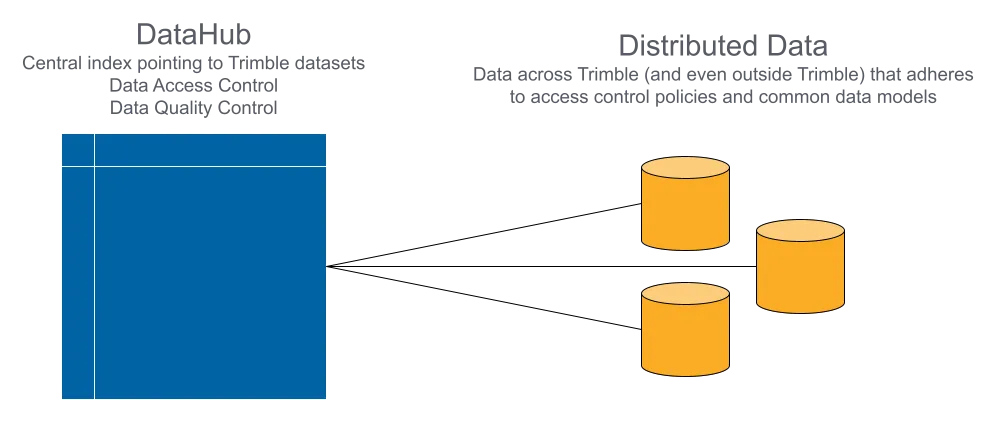
Product teams can take the following actionable steps to participate in Trimble’s data mesh strategy:
- Identify the priority data domains that are important to the product, and where those data domains are used in Trimble’s portfolio today (e.g. ‘Project’ is used in these 10 products). 16
- Engage with the Trimble Core Platform team to establish data ownership and data stewardship at the enterprise level.
- Establish collaboration agreements, roadmaps, or plans that commit to publishing datasets to DataHub.
Workflow Orchestration: Middleware & Capabilities at Trimble
The above data foundations are critical to realizing the following workflow strategies at scale.
But while the appreciation of the need for common data is still maturing, the focus on shared capabilities has increased at Trimble in the last year. Examples:
- The desire to use a scheduler service from one product team to another has been identified.
- The Construction Sector is actively exploring how to connect Viewpoint and ProjectSight with Trimble and non-Trimble products and ERPs.
- The desire for Forestry to use capabilities from Transportation is under discussion.
These discussions happen every day in Trimble, but a platform framework for realizing the sharing of these capabilities is not well understood. Without a clear strategy, Trimble could develop many point-to-point solutions.
Capability sharing and orchestration have been underappreciated features of the Core Platform for years: the Processing Framework17 is a dual-cloud, workflow orchestration service. It allows product teams to take existing capabilities—as functions, APIs, command line executables, etc.—and create modular web-enabled ‘Operations’ from those.
Modular workflow orchestration may be best described in terms of toy bricks. Modular means that Trimble products and services are broken down into their simplest valuable capabilities.
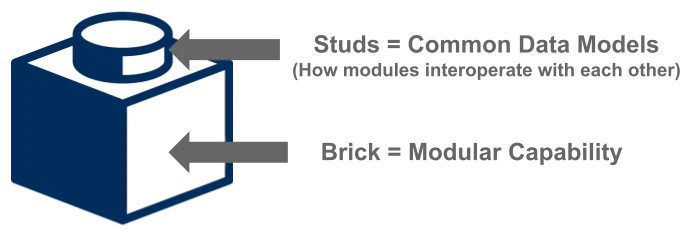
These capabilities must have well-understood interfaces: documented data models and often a well-documented API contract. If not well-standardized, the following steps of putting many modular capabilities together become difficult or impossible.
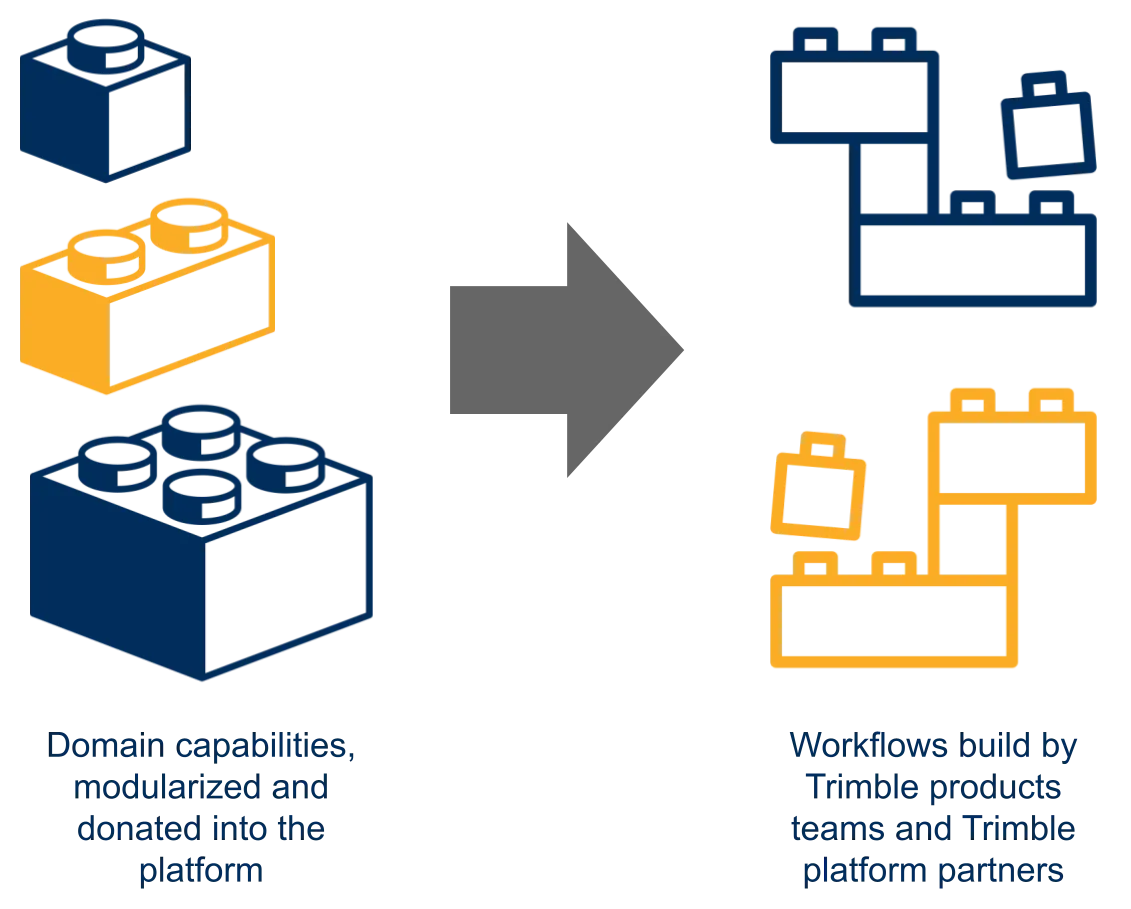
This pattern of modularizing domain capabilities is already realized and possible in the Processing Framework today. The following are a few examples of modular, sharable capabilities made available:
- File conversion from one file type to many other file types (one-to-many), e.g. CIS’s FileFlipper, Connect’s BIM transformation, and Geospatial’s GIS file assimilation
- Use of Geospatial’s eCognition imagery analysis capabilities within MEP’s LiveCount Cloud
- Orchestration: Convert a raster image to map tiles, and then create a multi-file object in Data Ocean for tile streaming within a map tile client.
The Processing Framework is limited today primarily due to underappreciation of its existence across the enterprise. Teams have not explored it, are quick to build ETL pipelines within product tech stacks, or if they have explored it, are not thinking about it in terms of a platform to share capabilities with other product teams. Below, we describe the shared responsibility model that allows product teams to focus on domain capabilities while the Core Platform builds the framework for making those capabilities web-enabled.
The Processing Framework only scratches the surface of workflow orchestration needs for Trimble. Ultimately, Trimble needs to expand this mission to include additional middleware capabilities to connect its workflows. To this end, the Core Platform team will pursue four related strategies to build common Workflow Orchestration for Trimble:
-
Rationalize existing middleware efforts within the Core Platform
The Core Platform has inherited many disparate middleware efforts, especially after integrating the Corp IS activities in the last two years. Mulesoft, Boomi, Snaplogic, WSO2, Safe FME, etc. represent significant opportunities for rationalization into a common middleware mission.
-
Elevate the understanding of Processing Framework within Trimble
Marketing and communications capabilities for the Core Platform team are lean. This means that urgent communications overshadow important and strategic communications. The Processing Framework is one Core Service that is victim to this reality. Bolstering communications about the Processing Framework, increasing the ability of the Engagement team to support onboarding to the Processing Framework, and building out user interfaces for visual development and use of the Processing Framework are three opportunities we will pursue in the coming years.
-
Expand our partnership with Safe Software
Safe Software is a Trimble partner that provides middleware capabilities through their flagship offering FME (Feature Manipulation Engine). Safe is well-known within the AECO and Geospatial industries as an open partner to all players in the space. But in the last several years, they have also significantly expanded their ‘generic’ middleware capabilities including general ERP and non-domain connections. We already use FME within the Processing Framework, and we are pursuing a deeper partnership that will expedite the onboarding of new Trimble capabilities into the Processing Framework via FME.
-
Pursue M&A opportunities in the middleware space
Product teams within Trimble are beginning to see the value of middleware as a scalable integration path between Trimble and non-Trimble software. There is growing recognition that point-to-point integration is not a scalable solution, and that there is a need for ‘point-to-many’ integration through readers and writers that operate against common data models. This pattern means that if integration between product A and product B exists, adding product C means the platform gets the benefit of those A and B integrations already on the platform. A Trimble M&A activity, codenamed Project Frog, is an example of an opportunity to further expand the workflow orchestration strategy already in motion within the Core Platform.
Shared Responsibility: How Trimble’s product teams provide capabilities into Trimble’s platform
The Core Platform efforts around Trimble’s data mesh and middleware cannot realize Trimble’s platform strategy on their own. The data types and capabilities that exist within Trimble’s domain-knowledgeable product teams are where the true value to our customers lies.
The playbook for moving toward a platform-first approach begins with building an inventory of valuable domain data types and capabilities. Product teams must think in terms of the capabilities that their products include. Some examples include:
- Trimble Connect reads BIM and CAD file types and ‘assimilates’ them down to their component data pieces.
- Applanix PosPac reads GNSS files and corrects for the trajectory of a kinematic rover.
- Trimble Inpho creates image mosaics from aerially triangulated images.
Each of these on its own is a small modular capability.
The following chart outlines specific concrete actions Trimble product teams must participate in to move forward on our platform strategy. These actions are split into actions that can be taken for data, and separate actions that can be taken for capabilities. But these two tracks need to stay informed and aligned in order to deliver value in the end.

Increasing the velocity of our platform strategy requires the Core Platform team to expand its capacity to engage with Trimble product teams. Faster execution will depend on three factors:
- Increased awareness amongst Trimble product teams of the long-term strategy and capabilities roadmaps. The Core Platform team is working on a communications strategy that prioritizes thought leadership and product awareness in business, product, and engineering leadership.
- Clear short-term and long-term value propositions for Trimble businesses to help them prioritize amidst other commitments to their customers and as part of Digital Transformation. Working with Trimble sector leadership and individual teams on this advocacy is a core long-term focus of the Core Platform team’s technical customer success function.
- Streamlined onboarding for engaged teams, with a focus on enabling self-serve onboarding of their data and capabilities. The team is currently scaling up its efforts to provide accurate, up-to-date documentation and tooling combined with solution architecture and direct assistance to make for an easy onboarding experience.
In the long term, it is critical to foster a community around the Trimble Platform and our joint responsibility to expand it. The most connected and scalable platform will be one that is supported by the Core Platform team but driven by our products and our ecosystem partners.
Trimble’s platform opportunity
In a platform-centric approach, Trimble must realize we are only one participant in our vision and mission to transform the way the world works and connect the physical and digital worlds. Not all platform data and capabilities will be Trimble capabilities. We may not always have 100% of the modular capabilities to realize our customers’ end-to-end workflows. An open platform18 strategy allows for partners—and sometimes even competitors—to provide capabilities into the Trimble platform. Ultimately this brings value to a wider audience to participate in the Trimble platform.
Trimble must expand the personas in our ecosystem to be successful. In a product-centric strategy, our traditional domain users are both our means and end to creating value to our business. The traditional model is simple: we built (and still will build) products that serve these domain users. Our products are the vehicles for our end users to transform the world. But in a platform-centric strategy, our means expand significantly to achieve the same end. Trimble data and capabilities become available to other solution developers who also serve end users in the industries we participate in. Trimble’s product teams must become comfortable with developers as customer personas, and these personas must be built into product strategies.
In support of developers as customers, the Core Platform team provides the foundational capabilities to deliver data and capabilities to the market. Cloud Console19 is the common place for developers to discover and subscribe to APIs—the interfaces to Trimble’s data and capabilities.
The go-to-market approach for developers as customers is being led through the Trimble Developer Program and Construction Cloud initiatives. These are led by James Gray and Patrick Stevenson, respectively. Over the coming years, we will see these go-to-market approaches expand to additional industry clouds. Regardless of the go-to-market strategy, Core Platform will continue to underpin the delivery of the capabilities being taken to this new market of developers on top of the Trimble platform.
Appendix A: Security, Reliability, Compliance, and Support
The value of Trimble’s Cloud Core Platform is directly tied to the level of trust associated with its services. To help address this requirement, the Core Platform’s Software Development Lifecycle (SDLC) is governed for availability, deployability, resiliency and risk management via industry standard DevOps and DevSecOps practices. This governance is implemented via investment into the Cloud Core Platform Operations team to support four strategic governance pillars:
- Site Reliability Engineering (SRE)
- Compliance
- Cloud Platform Support
- Sustainability
The Site Reliability Engineering group is a two region team of dedicated cloud engineers, implementing DevOps and DevSecOps practices across public clouds in compliance with stringent change management and security procedures. This team leverages advanced deployment models, Infrastructure-as-Code, and managed services that allow our development teams to utilize and monitor scalable cloud technologies. It has enabled wide and active collaboration with the Trimble CyberDefense team and implemented design and process controls supporting multiple assurance certifications.
The Compliance group collaborates with and coordinates Trimble’s General Regulatory Control (GRC) ecosystem to enable legal commercial compliance for revenue cycle systems and cybersecurity assurance certifications. This increases Trimble’s access to additional controlled and global markets when utilizing the Core Cloud Platform services.
Compliance outcomes have ramped rapidly over the last three years including facilitation of assurance certifications for ISO 27001 and NIST 800-171. Recently, this group added SOX IRGC control compliance for applications that are part of Trimble’s Digital Transformation effort. Moreover, the value outcomes from the continuum of cybersecurity assurance certifications are continuously reflected in our CAIQ20.
Cloud Platform Support is an internal customer-centric global team organized to resolve Trimble integrator obstacles and downstream Platform integration failures. They also serve as the technical and communication leads for Cloud Core Platform’s incident management. The Cloud Core Support (L3 / L4) team cooperates with Trimble Cloud AppOps (L1/L2) to detect, intake, route, escalate and resolve software degradation, outage and/or integration cases.
This team works against a framework supporting 24-hour Follow-the-Sun (US, India and Romania) monitoring, automated notification and case escalation. Moreover, the team facilitates assurance compliance via incident management for Cloud Core Platform service degradations.
Sustainability is a new and emerging value that the Core Platform Operations team is organizing to support. Sustainability initiatives will span across the Site Reliability Engineering, Compliance and Cloud Platform Support teams21.
The Sustainability value emerges from Cloud Platform’s historical investment in cost monitoring and transparent reporting. Recent investment has delivered end-to-end (cloud service provider and shared services allocations) reporting and anomaly monitoring for each service. This data stream is subsequently available for transparent depiction of cost recovery applied to Trimble sectors22.
Strategic roadmap for security, reliability compliance, and support
As adoption and reliance on the platform grow, so do the expectations about the operational maturity of the Core Services. The scope targeted for each strategy will generally evolve in line with the pace of Cloud Core Platform Adoption. Execution is dependent on applied investment.
- Site Reliability Engineering
- Evolve Cloud Core Platform services to a multi-region High Availability architecture.
- Operational maturity begins with service availability. When a Core Service like Trimble Identity experiences service degradation, the impacts are felt by all Trimble customers. Thus, it is necessary to prioritize non-functional work that ensures high availability alongside functional capabilities. Beginning with foundational services including Trimble Identity, Entitlement, and API Cloud, the Core Platform will prioritize High Availability over several functional requirements in 2023.
- Define Core Cloud Platform’s disaster recovery needs based on the objective constraints to Trimble’s customer-facing SLA(s).
- Scale up Vertical SRE deployment to support 24/7 follow-the-sun development.
- Scale up Horizontal SRE initiative capacity to support the Compliance Roadmap and dedicated horizontal SRE capability for security and cost efficiency initiatives.
- Balance risk management and see through end-of-life projects.
- Evolve Cloud Core Platform services to a multi-region High Availability architecture.
- Compliance
- 2023 Compliance Roadmap23
- Continue to build the inventory of privacy controls that align to global privacy legislation (e.g. GDPR, CAPA, etc.) and ISO 27002.
- Increase scope of assurance certifications ISO 2700X and NIST 800-171 to encompass additional legacy business systems as necessary.
- Complete an objective evaluation of FedRamp Moderate requirements vs Trimble commercial opportunities. Charter a program as necessary.
- Support Trimble Cyber Security’s strategy of increasing Trimble’s overall cybersecurity posture via leveraging Global Regulatory Controls.
- Extend visibility of Cloud Core Platform’s CAIQ to Trimble GRC ecosystem.
- Cloud Platform Support
- Scale L1-L4 support capacity against service adoption velocity.
- Integrate supportability design controls into Cloud Core Platform’s SDLC.
- Leverage follow-the-sun global support requirements to benefit from low-cost-country efficiencies. Plan support expansion into US early career, Mexicali, Chennai and Romania.
- Sustainability
- Implement Cloud Service Provider (AWS and Azure) sustainability instrumentation into Cloud Core Platform’s NextGen services portfolio.
- Generate, record and monitor SaaS product carbon footprints. Remediate deviations from linear carbon footprint growth inline with increased adoption.
- Define sustainability design controls for net new NextGen services and major version increments for existing services.
- Define design constraints to lower the carbon footprint for the Core Cloud Portfolio inline with Trimble’s stated science-based targets.
Appendix B: Three year roadmaps
| Core Services, Platform/Ecosystem (Link to detailed roadmaps) | 1H23 | 2H23 | 2024 | 2025 |
|---|---|---|---|---|
| Identity | - Add Sign in with Microsoft - Ability to select US or EU as the primary Identity region - High availability implementation for core components of TID stack, enabling rapid fail-over during outages - Portfolio Rationalization: EOL WSO2 EOL myprofile.trimble.com in favor of MyTrimble | - Addition of other data residency regions, starting with the UK - Improve mobile UX (e.g. simplicity for drivers on a tablet) - Ability for passwordless login (WebAuthN) - Portfolio Rationalization: EOL TIDv3 | - Incorporate API key functionality into MyTrimble to support integration with partner identities such as Esri, CAT, etc. - The ability for users to manage Active Sign-On Sessions - Pending discovery: Additional of additional administrative capabilities (requested by eBuilder and Viewpoint) | - Pending discovery: Improve use of mobile sign in via use of duo key fobs |
| Cloud Console & API Management | - Beta Release of updated Cloud Console - Support invite-only external partners in support launch of Developer Program - Add Azure IoT gateway capabilities to support Dual Cloud strategy | - General Availability of Cloud Console within Trimble - Launch of Events Services within Cloud Console - Rationalization or integration with Workflow Catalogs in Construction Cloud | - General Availability of Cloud Console outside of Trimble - Addition of Processing Catalog to facilitate workflow orchestration - Enforce scopes for API resources | - Curation of Industry Cloud API Catalogs - Elevation of Domain Capabilities into APIs, available through the Cloud Console |
| Profiles and Authorization | - Support (in-country) Data Residency for User Profile Data, starting with the EU - Define and document data models for User, Account, Application, and Device | - Profiles adopted by DX stack - Salesforce accounts are part of MDM - Publish initial reference datasets in DataHub - Portfolio rationalization: Sunset ProfileX | - Demonstrate use of a non-core platform service as a data domain owner, e.g. Trimble Connect for Projects - Enforce scopes in Trimble Identity for resource authorization - Rationalization: Sunset Trimble Object Registry | - Expand to deeper data domains within industry clouds - Utilize spaces to manage enterprise vs domain data domains |
| Events Service | - Entitlement v4 Events Available | - Continue to expand adoption to all remaining Core Platform services. | - Begin governing events maturity and standards as with APIs. - Move Events to Generally Available to Trimble once event governance is in place. | - Explore the pattern of Events pushed to data warehouse for product/feature usage analysis (may come earlier depending on urgency). |
| Workflow Orchestration & Processing Framework | - Complete containerization efforts in Azure - Evaluation of Project Frog as a contribution to Trimble’s middleware strategy | - Complete adoption of Connect onto Azure capabilities in Processing Framework - Integration of Project Frog into Trimble’s broader middleware strategy | - Addition of Processing Catalog to facilitate workflow orchestration | - Expand processing capabilities not non-asynchronous processing types (e.g. persistence) |
| - Emphasize the need for adoption for the success of Trimble’s workflow orchestration strategy. 2023 must be a year focused on shared responsibility with Trimble businesses. |
| Data & Analytics (Link to detailed roadmaps) | 1H23 | 2H23 | 2024 | 2025 |
|---|---|---|---|---|
| Data Governance | - Identify top 5 priority data domains to begin governing at enterprise level. - Identify data stewards for top 5 priority data domains. | - Document and constrain all enterprise data models through DataHub - Establish terms of use and consent flows around enterprise datasets | - Expand adoption of Data Governance operating model to be adoptable by sectors & divisions outside of the global Enterprise space - Coordinate with API & Functionality services to develop and implement data contracts and lifecycles | - Coordinate with appropriate SME groups, e.g., Central AI, to develop general-purpose product analytics tools to be incorporated into the Data Pipeline - Integrate automated data management tools, e.g., data deduplication, data enrichment/augmentation, private data identification, etc. |
| Data Hub and Data Ocean | - Explore narrowing the mission of DataHub to data discovery, protection, and governance. Look to utilize other services for data storage and querying, e.g. Snowflake. - Establish a DOMO dashboard for Data Ocean to measure data participation. | - Refine the DataHub user interface to improve discovery and accessibility. - Illustrate data mesh capabilities through indexing “outside the core” datasets. | - Emphasize data maturity and conformance to data governance within DataHub (tagging, searching, access control). | - ML Ops (e.g. monitoring datasets used in production for dataset health). - Productionalization of data—use of datasets in automated upstream model workflows. |
| Data Operations (Business Intelligence and Data Engineering) | - Implement initial Customer 360 dashboard in DOMO. - Build a DX measurement dashboard aligned to define financial OKRs and non-financial DX measures (e.g. customer-centric measures). | - Portfolio Rationalization: Complete Cognos sunset (April 2023). | - Provide services to help onboard new datasets to the DataHub to DOMO pipeline. | - Extend engagement: Develop and provide data management workshops, documented best practices. |
| Enabling systems and Processes (Link to detailed roadmaps) | 1H23 | 2H23 | 2024 | 2025 |
|---|---|---|---|---|
| Lead to CPQ | - Development of Free Trials - Sales creates single quote with subscriptions from two business units | - Customer Master approve legal entity name changes - Customer reviews, redlines, & signs final quote and contract | - Implementation of Guided Selling in CPQ - Complex configurations to support Hardware Subscription | Recommendation engine based on AI to optimize dollar value per contract |
| Commerce | - Enable B2C storefront for self-service - Enhance B2B storefront with additional capabilities - Enhance checkout providing customer detailed data | - Custom email notifications based on product purchased - UX enhancements to storefront, product pages, and Checkout - Migration of Commerce Billing to Salesforce CPQ Billing | - Adoption of Salesforce Order Management - Deployment to Indirect | Headless commerce for In-App Purchases |
| Orders & Billing | - Subscription Order aligned, validated, and finalized - Direct customer receives invoice including software and/or services | - Billing Team amends, cancels, rebills, & resolves credit issues - Payment Gateway is developed for CC, Direct-Debits, and PayPal Consolidate Billing for Commerce and Direct-via-Rep on CPQ Billing | Salesforce Order Management | Alerts to determine customers likely to default on invoices |
| Entitlement | - Entitlements can be created for explicit bundles - Transition layer allowing co-functioning of EMSv3 and EMSv4 - Enterprise Based Licensing | - Ability to provide offline access - Data analytics for internal users | - Enable License Keys - Device-based licenses as part of named-entity licensing | Usage to handle many units of measure |
| License Management and Customer Profiles | - Product users can view and access their products - Customer Admins can view & manage subscription licenses - Commerce Customers can self - serve evergreen subscription renewals | - Admins can upgrade,downgrade & repurchase termed licenses - Admins can manage billing & payment - Admins can manage users and teams | - Users can receive relevant product recommendations - Mobile MyTrimble Access - Users can manage devices | Unified customer forums |
| Support | - Create, reassign, & close cases - Support Reps can manage entitlement information - Customers receive surveys after interactions | - Customers can chat with bots and agents - Customers can call Horizontal Support - Support Reps can see the SLA of every case | - Support Users can see hardware on customer account - Support can track bugs in Jira | - Deflection handling via ML based Chat Bots - Support experience embedded in Product |
Footnotes
-
Trimble’s Data Future: Data-as-a-Product delivered via Data Mesh ↩
-
The Core Platform team will seed datasets in DataHub in early 2023 from the data domains already within the Core Platform: Billing Account, Product, User, and Device. ↩
-
Cloud Core’s Consensus Assessment Initiative Questionnaire (CAIQ) v3.1 ↩