Language Internationalization Prioritization for Trimble as a Platform Company
Author(s): Jared Bloch, Sr. Director, Core Platform
Peer Reviewers(s):
- Amy Ward, Director of Customer Experience
- David Kohler, VP, Core Platform
- Devon Sparks, Trimble Distinguished Engineer
Last Reviewed: September 2024
Correcting an unsustainable language support problem
Trimble supports a wide range of industries and geographies worldwide. This breadth has been built and acquired over decades of customer acquisition by different product teams. However, this breadth brings challenges for supporting common languages within a platform where consistency is expected across the entire user experience.
For example, here are the current languages supported by three different Trimble Products. Languages in Bold are languages uniquely supported by only one product among these three. There are also examples of languages inconsistently supported in some products and not in others.
| Trimble Connect | Tekla Structures | WorksOS |
|---|---|---|
| Chinese (Simplified) | Chinese (Simplified) | |
| Chinese (Traditional) | Chinese (Traditional) | |
| Czech | Czech | |
| Danish | Danish | |
| Dutch | Dutch | Dutch |
| English | English | English |
| Finnish | Finnish | |
| French | French | French |
| German | German | German |
| Hungarian | ||
| Italian | Italian | Italian |
| Japanese | Japanese | Japanese |
| Korean | Korean | |
| Norwegian | Norwegian | |
| Polish | ||
| Portuguese | Portuguese | |
| Portuguese (Brazilian) | ||
| Russian | Russian | |
| Spanish | Spanish | Spanish |
| Swedish |
The most ubiquitous platform service, Trimble Identity, has struggled to keep up, approaching the problem by supporting a superset of languages that Trimble supports.
Trimble Identity supports an astounding 27 languages!
| Trimble Identity |
|---|
| Bulgarian |
| Chinese (Simplified) |
| Chinese (Traditional) |
| Czech |
| Danish |
| Dutch |
| English US |
| German |
| Greek |
| Finnish |
| French |
| Hungarian |
| Italian |
| Japanese |
| Korean |
| Norwegian Bokmål |
| Polish |
| Portuguese Brazil |
| Portuguese Portugal |
| Romanian |
| Russian |
| Slovenian |
| Spanish (Latin America) |
| Spanish (Spain) |
| Swedish |
| Thai |
| Turkish |
And still Trimble Identity regularly receives requests to support additional languages.
This approach is unsustainable. As Trimble’s strategy is to centralize more user administration experiences (e.g., Admin Console, Trimble Identity) while also increasing the bundling and cross-selling of products, this means more parts of the platform portfolio (and products) must be considered for common language support. A request for adding language support to Trimble Identity needs to be recognized as a request for support for the entire Trimble platform to support that language.
Prioritizing language support
To manage the “loudest customer in the room” problem, Trimble can take a data-driven approach to measure language support prioritization, using data from at least these sources:
- LRP strategic go-to-market regions—Trimble sectors often specify the geographic regions that are priorities for the business. This includes existing markets as well as emerging markets. These datasets will be used in conjunction with the following.
- Sales data—Trimble has existing sales data by geography. This data can determine where products are successfully being sold and drive language supportability decisions.
- Users’ geography data—Trimble Identity, like many Trimble products, contains geographic data about sign-in locations for users worldwide. Trimble Identity will provide this information at the macro level to avoid data privacy concerns. This data will include the number and percentage of users per country.
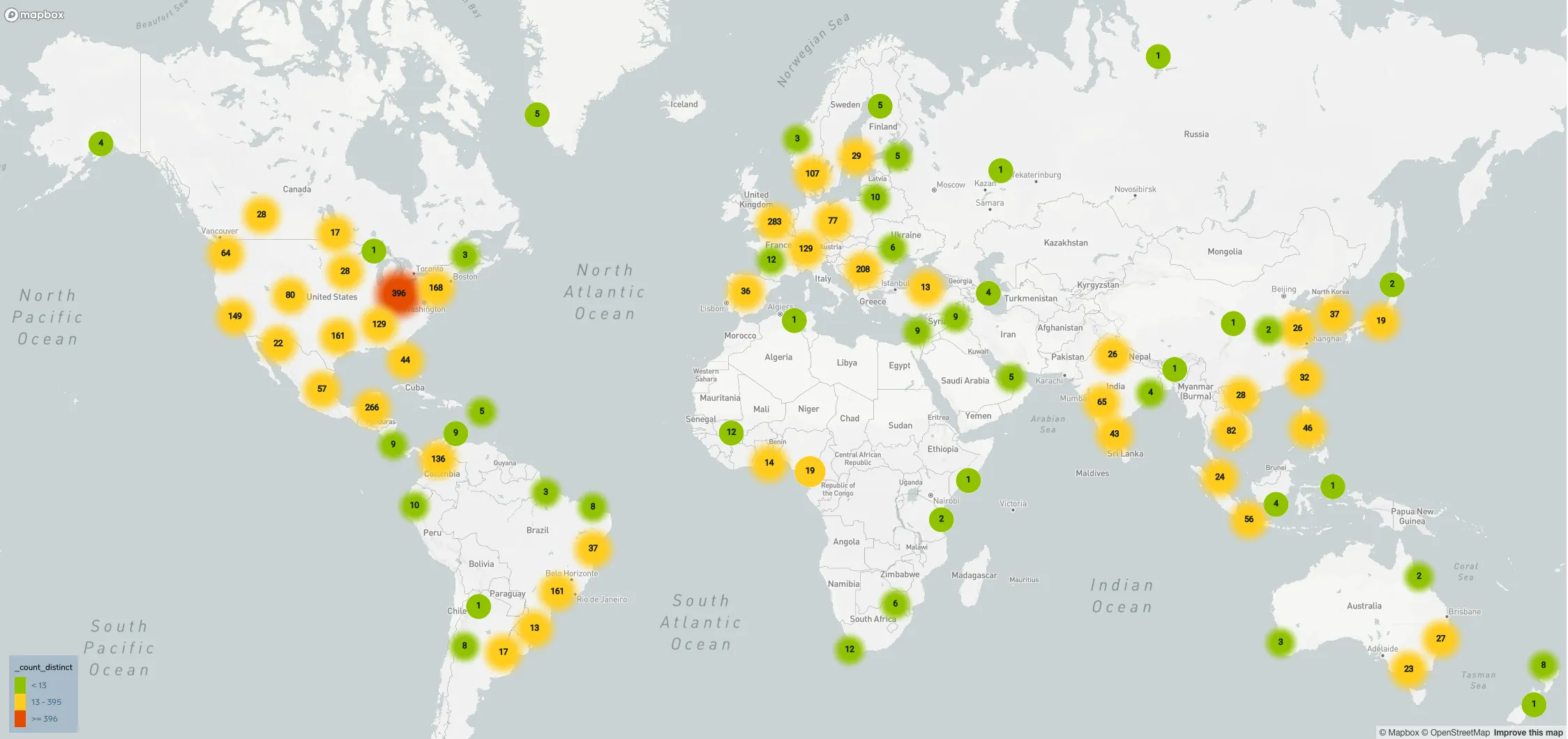
Caption: Trimble Identity session data, geographically dispersed.
The following countries (note: not languages in this list) represent the top 20 by count of Trimble Identity sessions:
| Rank | Country | % of TID sessions (including SketchUp) | % of TID sessions (excluding SketchUp)* |
|---|---|---|---|
| 1 | US - United States | 58.5% | 58.4% |
| 2 | DE - Germany | 3.2% | 4.5% |
| 3 | FR - France | 2.7% | 3.4% |
| 4 | BR - Brazil | 2.6% | 1.3% |
| 5 | IE - Ireland | 2.6% | 3.9% |
| 6 | NL - Netherlands | 2.5% | 3.4% |
| 7 | CA - Canada | 2.3% | 2.9% |
| 8 | IN - India | 2.2% | 1.7% |
| 9 | GB - United Kingdom | 1.9% | 2.3% |
| 10 | AU - Australia | 1.5% | 1.8% |
| 11 | ID - Indonesia | 1.1% | 0.3% |
| 12 | CH - Switzerland | 1.0% | 1.6% |
| 13 | MX - Mexico | 1.0% | 0.6% |
| 14 | TH - Thailand | 0.9% | 0.4% |
| 15 | PH - Philippines | 0.7% | 0.4% |
| 16 | SG - Singapore | 0.7% | 0.9% |
| 17 | PL - Poland | 0.7% | 0.8% |
| 18 | SE - Sweden | 0.7% | 1.0% |
| 19 | KR - S. Korea | 0.6% | 0.4% |
| 20 | BE - Belgium | 0.6% | 0.8% |
| Everywhere else | 12.0% | 9.4% |
*SketchUp accounts for 65% of all Trimble Identity monthly active users. Notable differences when filtering SketchUp out include Finland and Norway making the top 20 without SketchUp’s data.
A data-driven approach like this can raise important questions, including:
- Are countries like India, Indonesia, and Switzerland well-served by English, or would Trimble be better off supporting localized languages for those markets?
- Are languages that did not make this list but that Trimble products already support worth continuing to invest in, such as Chinese, Russian, and Hungarian?
Trimble Language Strategy
In 2024, Trimble established a language council under the Digital Transformation (DX) mission. Currently led by Amy Ward, this council quickly established a three-tier structure for language priopritization:
Core Languages
Core Languages will be used for all customers’ interactions online, written and verbal. And will be default when no other language is available.
Common Touch Points
Common touchpoints for all customers would have online and written documents .
Process-Specific
Process-specific offerings may have localized language options and/or use core language as defaults.
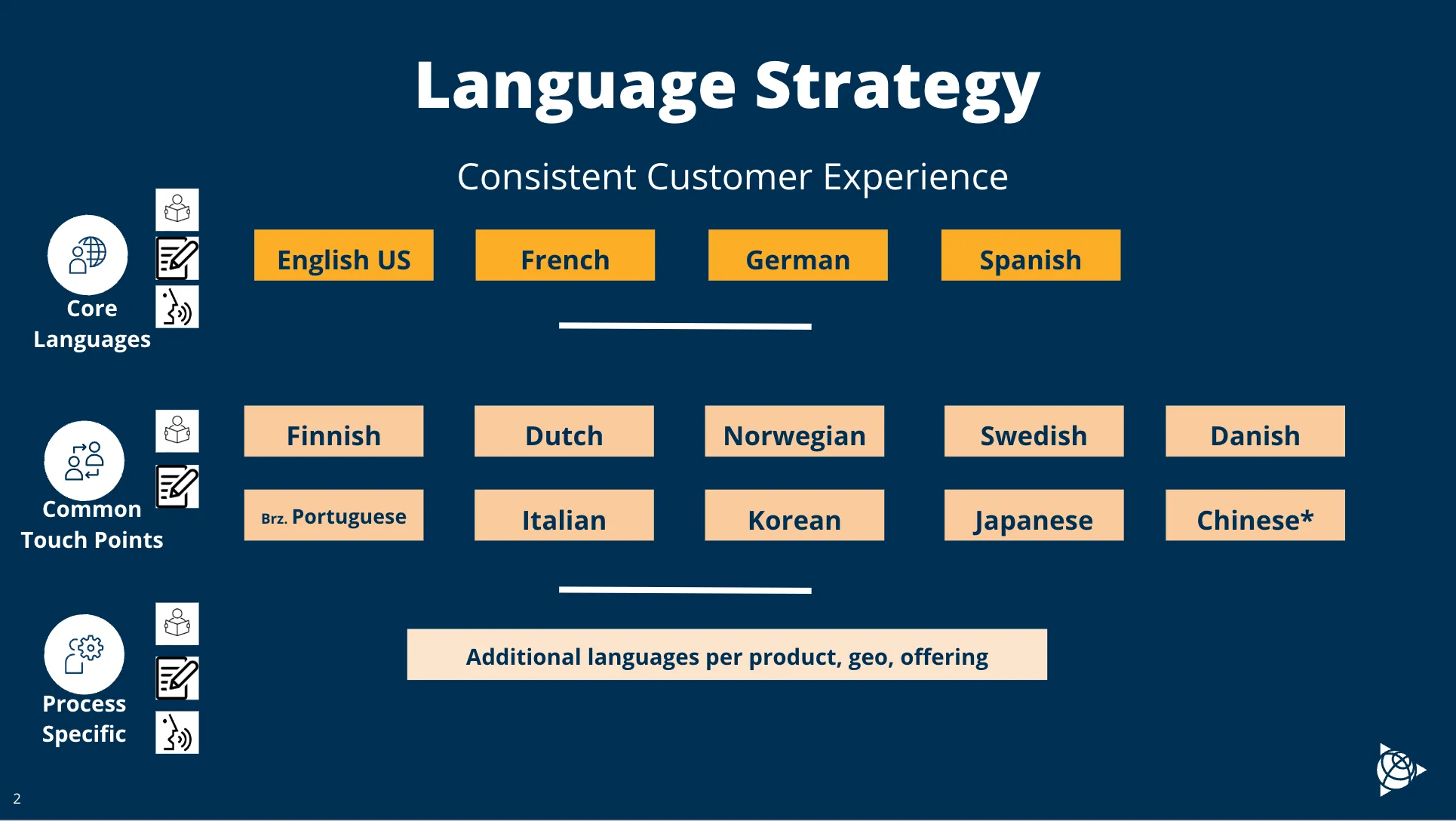
The above drawing lists the current languages identified in each category.
Do you have a request to add a new language to Trimble’s priority list?
The Trimble Cloud Core Platform team will follow the guidance from Trimble’s Language Council. Any new language requests should be validated through the Trimble Language Council for prioritization.