Federated Data Governance at Trimble
Trimble’s governance policies, framework, and federated operating model are foundational to productizing data. By adopting a formal approach to data governance, Trimble can realize the “Connect & Scale” initiative, but what does formal data governance look like?
As a component of data management, data governance is the application of a policy framework that ensures quality, accessibility, coherence, and trustworthiness of data assets throughout their lifecycle. Governance includes essential components, such as:
- Processes for data classification
- Policies for data security, privacy, access, and compliance
- Reference data, master data, and metadata
- Processes to ensure data quality
- Designs for data interoperability
- Enterprise glossaries
To accommodate the disparate domains of Trimble’s centralized and decentralized data, Trimble is establishing an operating model that includes federated data governance.
Federated data governance enables Trimble to be strictly prescriptive with the management of data that is valuable to the whole organization while also providing tooling and processes for business-specific data domains. With a common framework, Trimble can establish a robust mesh of data assets and systems. Localized complexity is balanced against an enterprise-level perspective to produce domain-specific subject areas along business lines or business functions, including for example user, account, and product data.
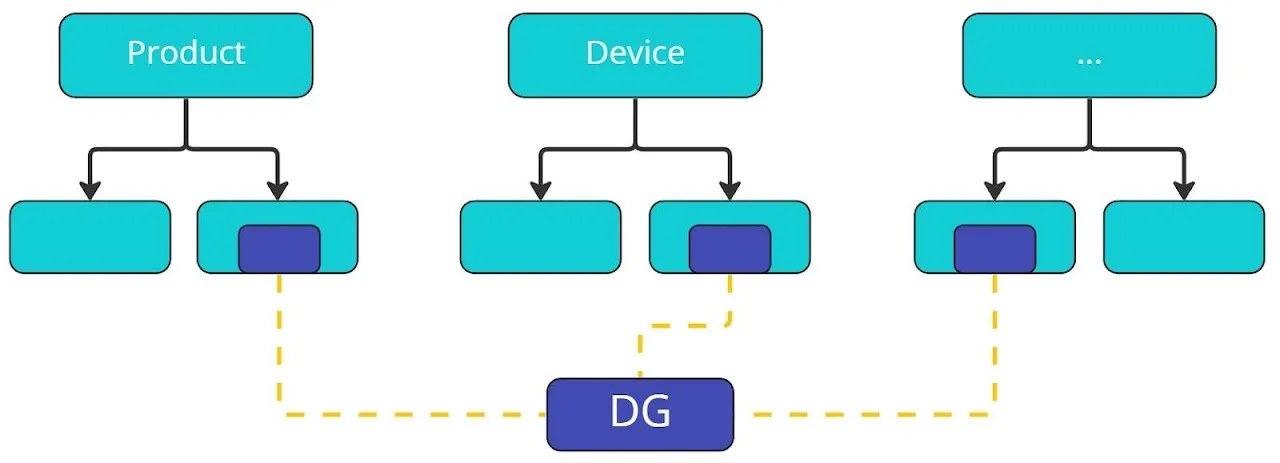
At an enterprise level, data governance defines key roles, responsibilities, controls, and processes. These definitions must be paired with the components of data policy, which include:
- Adhering to contractual and regulatory obligations
- Constraining data attributes to reference data
- Enabling interoperability by using common data contracts across systems
- Defining access models that align with business requirements
- Tracking data lineage throughout the data lifecycle
- Providing robust documentation of the value and structure of data
The roles and responsibilities of implementing federated data governance must be distributed across an organization. And while Trimble Cloud is uniquely positioned to take ownership over domains within their purview, Trimble also enlists the participation of every division to represent their own data domains and systems.
Participation requires some key roles from these divisions:
- Data governance lead
- Data architect
- Data owner
- Data steward
- Data security expert
- Data privacy engineer
Beginning with presently-owned data domains, Trimble Cloud aims to refine the processes of data governance and establish an exemplary case study; subsequently, Trimble will expand the scope to include domains from specific business areas and with a diverse network of data stewards. In this phased approach, along with the coordination of key roles in a federated data strategy, Trimble Cloud embarks on a journey towards operationalizing data governance.