Trimble leverages a multi-cloud strategy
Author(s): Jared Bloch and David Kohler
Last Reviewed: February 2024
In 2022, the Trimble Cloud Core Platform group published a set of core principles for Trimble’s platform.
One of these principles states:
Trimble’s Core Platform supports Trimble’s multi-cloud strategy.
What does a multi-cloud strategy mean?
- The Core Platform supports data and processing workflows on the cloud vendor that Trimble’s applications require. Application may have measurably valid business need to utilize specific cloud providers.
- The Core Platform supports our spending commitments to Azure and AWS and helps forecast our spending to meet those commitments.
- The Core Platform supports the Azure IP co-sell-ready route to market and the requirements to meet co-sale readiness. (more on this below)
- A multi-cloud strategy gives the Core Platform the flexibility to select the best solution from the best vendor offering for the given need.
- Moving data across cloud providers can be costly. The Core Platform multi-cloud strategy enables Trimble teams to manage ingress and egress costs for ‘data heavy’ workflows.
What Core Services are already multi-cloud capable?
These Core Services already support multi-cloud capabilities:
- Data Ocean - store data at rest in Azure or AWS
- IoT - leverage Azure or AWS IoT gateways
- Processing Framework - deploy processing functions via Kubernetes on Azure or AWS
- API Cloud (API gateway) - leverage Azure or AWS API gateways
These Core Services do not have any active plans to add multi-cloud capabilities, or it is not applicable:
- Trimble Identity
- Profiles
What determines the need for a service to be multi-cloud or not?
In 2010, a software engineer named Dave McCrory wrote about ‘Data Gravity,’ the idea that data is what accumulates the most mass in cloud-based platforms. He writes, “Data, if large enough, can be virtually impossible to move.” (McCrory 2010)
Following this principle, we have built the Core Platform to be as close to Trimble customers’ data as possible. Data Ocean and IoT have supported Azure and AWS for a while. More recently, Processing Framework workflows can be executed within Azure and AWS, close to these data repositories.
These three services are the platform’s most significant data and processing generators. The next tier of services (API Cloud, Events, and Data Hub) does not have the data and cost footprint that the initial set does. However, as time progresses, this will evolve. And thus, the basic pattern developed with the first-tier services will be applied to these.
Additionally, the pattern developed to support AWS and Azure is not limited to these two vendors. It is designed to be extended. It is already being looked at in how we could better manage compliance (FedRAMP) and privacy challenges (geo-isolation). And it allows us to extend it if expanding to the Google Cloud Platform is desired. And finally, there is a possibility that it could even allow us to extend into our customers’ cloud infrastructure.
How are costs managed?
In addition to providing multi-cloud flexibility, the Core Platform services are developed to support a shared responsibility model. (cloudsecurityalliance.org, 2020) On behalf of our products, the Core Platform services manage the data security and compliance responsibilities while delivering a shared context experience. To accomplish this, the services require a global control plane. And since these services all predated our current relationship with Microsoft, the control planes have been developed within AWS.
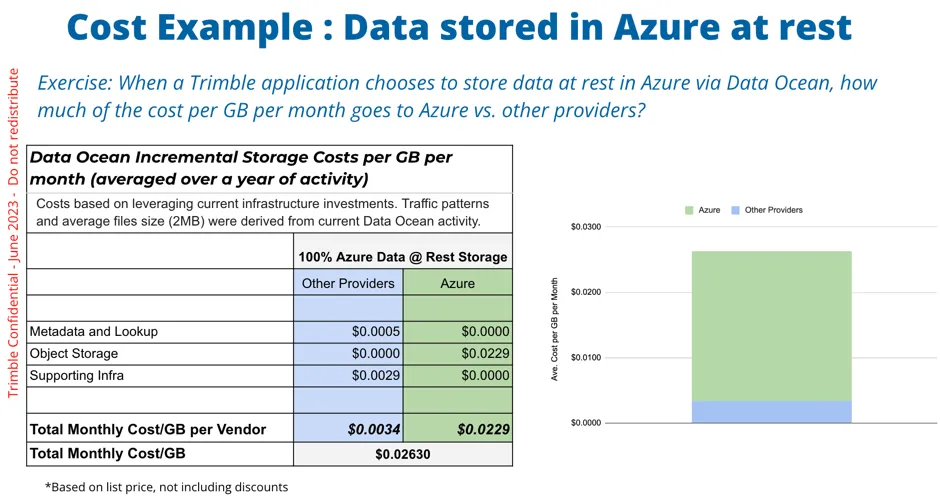
Trimble’s Azure and AWS contracts each have significant spend targets. Considering the global control plane’s value, its cost to run is marginal in the overall cost to run the services. This can be illustrated in a Data Ocean example (see Fig). It might be noted that the cost per GB of raw storage in Azure is slightly higher than in AWS. This difference will continue to shrink as Azure’s offering achieves parity with AWS, and our experience in more completely leveraging Azure increases.
How does this impact the Microsoft Azure IP co-sell opportunity?
Microsoft outlines the requirements for co-sell status in their Commercial marketplace certification policies. The critical provision is as follows:
3000.2 Azure IP co-sell incentive status
Offers must be built on or built for Azure.
Azure Applications, Azure Containers, IoT Edge Modules, SaaS, and VMs must meet the following requirements:
Your organization must meet or exceed $100,000 USD of Azure consumed revenue over a trailing 12-month period, or your offer must have a cumulative marketplace billed revenue of $100,000 USD.
For SaaS offers: more than 50% of your offer’s infrastructure must run on Azure.
This last item warrants more clarification. How is 50% measured?
In 2023, the Trimble Cloud Core Platform team engaged our Microsoft partnership team to evaluate four Core Services: Data Ocean, Processing Framework, IoT, and API Cloud. The purpose of this engagement was to certify that use of these Core Services expedites Microsoft Azure IP co-sell readiness for Trimble applications that want to sell through this route to market. While these four services will not be sold directly, they underpin Trimble’s solutions.
These services have been certified by Microsoft for supporting Azure IP co-sell readiness. This means that leveraging these Core Services almost guarantees (expedites, at a minimum) the co-sell readiness of Trimble applications built on these Core Services.